botanix

botanical illustrations by milly acharya


  • Home
  • About
  • Contact
  • Résumé
  • Index

Archive for October, 2008

Tropaeolum Majus

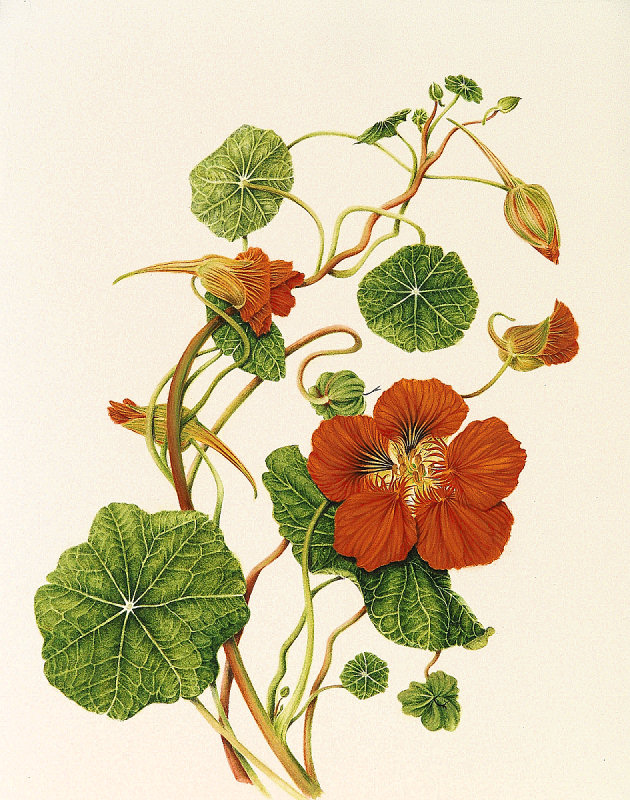
Tropaeolum majusTropaeolum majus (Nasturtium)

To Linnaeus, the venerable giver of plant names, the broad circular leaves suggested battle-shields and the the flowers reminded him of helmets stained with blood. From the Latin for trophy, Tropaeolum, the plant derived its name.  Its resemblace to the peppery taste and flavor of watercress, which actually belongs to the genus Nasturtium, Latin for pungency, led to its other name—Indian cress.
If you observe the sinuous stems, translucent with sap, and the way they branch out to support leaves of varying sizes, some quite enormous, you will notice the veins forming harlequin patterns. The buds show up with a little spur, curling like a comma. And then they unfurl, slowly, tantalizingly, opening to reveal dark guiding tracks on two petals leading to nectar sacs while the three remaing serve as a landing pad for a visiting bee. When the petals eventually wither and drop, a seed remains—pale green, ridged, globular. See more »

macharya :: Oct.24.2008 :: Tropaeolum majus :: Comments Off

Wisteria

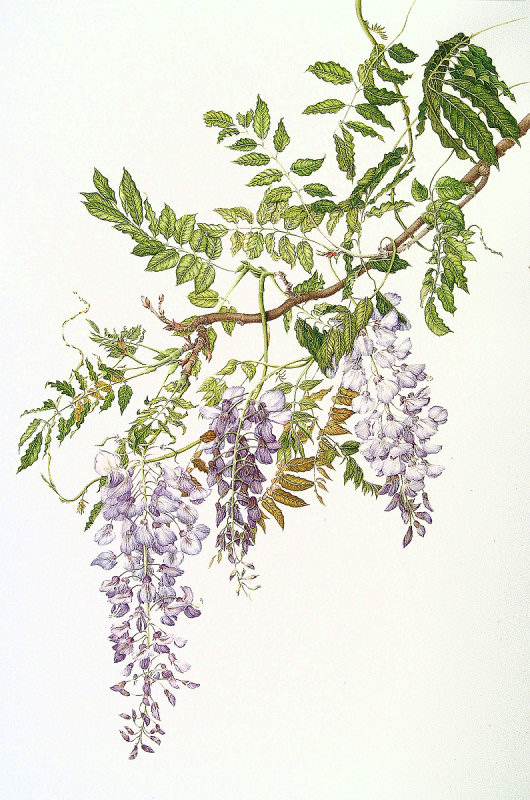
WisteriaWisteria sinensis (Chinese Wisteria)

Originally called Glycinia, after the Greek “glykys” for sweet, renowned American naturalist Thomas Nuttall renamed the wisteria in the 1800s to honor Dr. Caspar Wistar (1761 – 1818), a professor of anatomy at the University of Pennsylvania, President of the American Philosophical Society, and a personal friend of Thomas Jefferson.

Chinese wisteria is a deciduous vine growing vigorously to heights of 25’ or more,  has been known to destroy other plants, trees, supports and even houses, its delicate, long racemes of mildly-fragrant, pea-like, blue-violet flowers notwithstanding. In older vines stems become twisted, massive, with the heft and girth of tree-trunks. See more »

macharya :: Oct.24.2008 :: Wisteria :: Comments Off

Ipomoea purpura

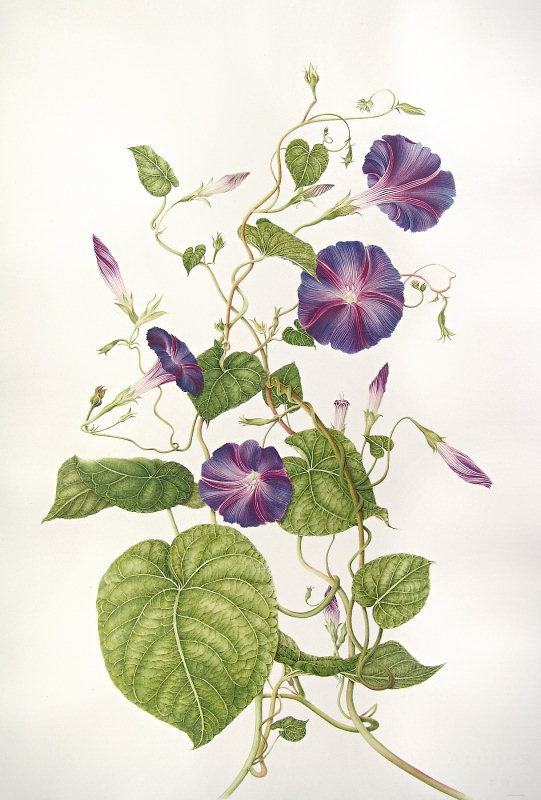
IpomoeaIpomoea purpura (Morning Glory)
Genus: Ipomoea purpurea
Family: Convolvulaceae
Group: Dicot

Ips is the Greek word for  worms. Ipomoea, or worm-like, describes the twining growth bait of this genus. However, it has undergone many name changes in its history. Starting off as Pharbitis purpurea incarnate, then Convolvulus major, followed by Convolvulus pupurea, it was only in the 20th century that the Morning Glory earned its current name. Because the flowers open at night or in diffuse light and last only a single day, saluting the sun, the name is well-deserved—though quite a contrast to “worm-like”! See more »

macharya :: Oct.24.2008 :: Ipomoea purpura :: Comments Off

  • recent additions

    • Prunus cerasus
    • Nymphaea capensus
    • Iris reticulata
    • Cornus florida
    • Allium sativum 2010
  • portfolio

    • Alcea rosea
    • Allium
    • Aquilegia
    • Bougainvilla glabra
    • Citrus
    • Clematis
    • Convallaria majalis
    • Cornus florida
    • Datura
    • Delphinium
    • Digitalis
    • Galanthus nivalis
    • Hibiscus
    • Ipomoea purpura
    • Iridaceae
    • Iris reticulata
    • Kniphofia uvaria
    • Lathyrus odoratus
    • Lilium
    • Magnolia soulangeana
    • Malus pumilus
    • Muscari
    • Myosotis scorpioides
    • Nigella damascena
    • Not-so-still Life
    • Nymphaea capensus
    • Papaver orientale
    • Polygonatum commutatum
    • Prunus cerasus
    • Pyrus
    • Raphanus sativus
    • Red onion
    • Rhododendron
    • Tropaeolum majus
    • Tulipa
    • Viola tricolor
    • Vitis vinifera
    • Wisteria
    • Zantedeschia aethiopica

botanix © 2010
Based on Theme
More from Baltic Light